This is similar to a hybrid
tuner, except there are two
separate tuners on the card.
One can watch analog while
recording digital, or vice
versa. The card operates as
an analog tuner and a digital
tuner simultaneously. The
advantages over two
separate cards are cost and
utilization of expansion slots
in the computer. As many
regions around the world
convert from analog to
digital broadcasts, these
tuners are gaining
popularity.
Like the analog cards, the
Hybrid and Combo tuners can
have specialized chips on the
tuner card to perform the
encoding, or leave this task
to the CPU. The tuner cards
with this 'hardware
encoding' are generally
thought of as being higher
quality.[citation needed]
Small USB tuner sticks have
become more popular in
2006 and 2007 and are
expected to increase in
popularity. These small
tuners generally do not have
hardware encoding due to
size and heat constraints.
While most TV tuners are
limited to the radio
frequencies and video
formats used in the country
of sale, many TV tuners used
in computers use DSP, so a
firmware upgrade is often all
that's necessary to change
the supported video format.
Many newer TV tuners have
flash memory big enough to
hold the firmware sets for
decoding several different
video formats, making it
possible to use the tuner in
many countries without
having to flash the firmware.
However, while it is
generally possible to flash a
card from one analog format
to another due to the
similarities, it is generally not
possible to flash a card from
one digital format to another
due to differences in decode
logic necessary.
Many TV tuners can function
as FM radios; this is because
there are similarities
between broadcast
television and FM radio. The
FM radio spectrum is close to
(or even inside) that used by
VHF terrestrial TV broadcasts.
And many broadcast
television systems around
the world use FM audio. So
listening to an FM radio
station is simply a case of
configuring existing
hardware.
Wednesday, April 21, 2010

Video capture
Video capture cards are a
class of video capture
devices designed to plug
directly into expansion slots
in personal computers and
servers. Models from many
manufacturers are available;
all comply with one of the
popular host bus standards
including PCI, newer PCI
Express (PCIe) or AGP bus
interfaces.
These cards typically include
one or more software drivers
to expose the cards' features,
via various operating
systems, to software
applications that further
process the video for specific
purposes. As a class, the cards
are used to capture baseband
analog composite video, S-
Video, and, in models
equipped with tuners, RF
modulated video. Some
specialized cards support
digital video via digital video
delivery standards including
Serial Digital Interface (SDI)
and, more recently, the
emerging HDMI standard.
These models often support
both standard definition (SD)
and high definition (HD)
variants.
While most PCI and PCI-
Express capture devices are
dedicated to that purpose,
AGP capture devices are
usually included with the
graphics adapted on the
board as an all-in-one
package. Unlike video
editing cards, these cards
tend to not have dedicated
hardware for processing
video beyond the analog-to-
digital conversion. Most, but
not all, video capture cards
also support one or more
channels of audio.
There are many applications
for video capture cards
including converting a live
analog source into some type
of analog or digital media,
(such as a VHS tape to a DVD),
archiving, video editing,
scheduled recording (such as
a DVR), television tuning, or
video surveillance. The cards
may have significantly
different designs to
optimally support each of
these functions.
One of the most popular
applications for video
capture cards is to capture
video and audio for live
Internet video streaming.
The live stream can also be
simultaneously archived and
formatted for video on
demand. The capture cards
used for this purpose are
typically purchased,
installed, and configured in
host PC systems by hobbyists
or systems integrators. Some
care is required to select
suitable host systems for
video encoding, particularly
HD applications which are
more affected by CPU
performance, number of CPU
cores, and certain
motherboard characteristics
that heavily influence
capture performance.
class of video capture
devices designed to plug
directly into expansion slots
in personal computers and
servers. Models from many
manufacturers are available;
all comply with one of the
popular host bus standards
including PCI, newer PCI
Express (PCIe) or AGP bus
interfaces.
These cards typically include
one or more software drivers
to expose the cards' features,
via various operating
systems, to software
applications that further
process the video for specific
purposes. As a class, the cards
are used to capture baseband
analog composite video, S-
Video, and, in models
equipped with tuners, RF
modulated video. Some
specialized cards support
digital video via digital video
delivery standards including
Serial Digital Interface (SDI)
and, more recently, the
emerging HDMI standard.
These models often support
both standard definition (SD)
and high definition (HD)
variants.
While most PCI and PCI-
Express capture devices are
dedicated to that purpose,
AGP capture devices are
usually included with the
graphics adapted on the
board as an all-in-one
package. Unlike video
editing cards, these cards
tend to not have dedicated
hardware for processing
video beyond the analog-to-
digital conversion. Most, but
not all, video capture cards
also support one or more
channels of audio.
There are many applications
for video capture cards
including converting a live
analog source into some type
of analog or digital media,
(such as a VHS tape to a DVD),
archiving, video editing,
scheduled recording (such as
a DVR), television tuning, or
video surveillance. The cards
may have significantly
different designs to
optimally support each of
these functions.
One of the most popular
applications for video
capture cards is to capture
video and audio for live
Internet video streaming.
The live stream can also be
simultaneously archived and
formatted for video on
demand. The capture cards
used for this purpose are
typically purchased,
installed, and configured in
host PC systems by hobbyists
or systems integrators. Some
care is required to select
suitable host systems for
video encoding, particularly
HD applications which are
more affected by CPU
performance, number of CPU
cores, and certain
motherboard characteristics
that heavily influence
capture performance.
SDHC (Secure DigitalHigh Capacity, SD 2.0)
SDHC (Secure Digital High
Capacity, SD 2.0) is an
extension of the SD standard
which increases card's
storage capacity up to 32 GB.
SDHC cards share the same
physical and electrical form
factor as older (SD 1.x) cards,
allowing SDHC-devices to
support both newer SDHC
cards and older SD-cards. To
increase addressable storage,
SDHC uses sector addressing
instead of byte addressing in
the previous SD standard.
Byte addressing supported
card capacities up to 2GB,
whereas sector addressing
can theoretically support
capacities up to 2 TB (2048
GB). The current standard
limits the maximum capacity
of an SDHC card to 32 GB. (It is
expected that the SDHC
specification will be revised
in the future to allow card
capacities greater than 32
GB.) SDHC cards will not work
in devices designed to the
older SD 1.x specification.
The SDHC trademark is
licensed to ensure
compatibility.
Capacity, SD 2.0) is an
extension of the SD standard
which increases card's
storage capacity up to 32 GB.
SDHC cards share the same
physical and electrical form
factor as older (SD 1.x) cards,
allowing SDHC-devices to
support both newer SDHC
cards and older SD-cards. To
increase addressable storage,
SDHC uses sector addressing
instead of byte addressing in
the previous SD standard.
Byte addressing supported
card capacities up to 2GB,
whereas sector addressing
can theoretically support
capacities up to 2 TB (2048
GB). The current standard
limits the maximum capacity
of an SDHC card to 32 GB. (It is
expected that the SDHC
specification will be revised
in the future to allow card
capacities greater than 32
GB.) SDHC cards will not work
in devices designed to the
older SD 1.x specification.
The SDHC trademark is
licensed to ensure
compatibility.
Multi-core processor
A multi-core processor is a
processing system composed
of two or more independent
cores. The cores are typically
integrated onto a single
integrated circuit die (known
as a chip multiprocessor or
CMP), or they may be
integrated onto multiple dies
in a single chip package. A
many-core processor is one
in which the number of cores
is large enough that
traditional multi-processor
techniques are no longer
efficient — this threshold is
somewhere in the range of
several tens of cores — and
likely requires a network on
chip.
A dual-core processor
contains two cores, and a
quad-core processor contains
four cores. A multi-core
processor implements
multiprocessing in a single
physical package. Cores in a
multi-core device may be
coupled together tightly or
loosely. For example, cores
may or may not share caches,
and they may implement
message passing or shared
memory inter-core
communication methods.
Common network topologies
to interconnect cores
include: bus, ring, 2-
dimensional mesh, and
crossbar. All cores are
identical in homogeneous
multi-core systems and they
are not identical in
heterogeneous multi-core
systems. Just as with single-
processor systems, cores in
multi-core systems may
implement architectures
such as superscalar, VLIW,
vector processing, SIMD, or
multithreading.
Multi-core processors are
widely used across many
application domains
including: general-purpose,
embedded, network, digital
signal processing, and
graphics.
The amount of performance
gained by the use of a multi-
core processor is strongly
dependent on the software
algorithms and
implementation. In
particular, the possible gains
are limited by the fraction of
the software that can be
parallelized to run on
multiple cores
simultaneously; this effect is
described by Amdahl's law.
In the best case, so-called
embarrassingly parallel
problems may realize
speedup factors near the
number of cores. Many
typical applications,
however, do not realize such
large speedup factors and
thus, the parallelization of
software is a significant on-
going topic of research.
processing system composed
of two or more independent
cores. The cores are typically
integrated onto a single
integrated circuit die (known
as a chip multiprocessor or
CMP), or they may be
integrated onto multiple dies
in a single chip package. A
many-core processor is one
in which the number of cores
is large enough that
traditional multi-processor
techniques are no longer
efficient — this threshold is
somewhere in the range of
several tens of cores — and
likely requires a network on
chip.
A dual-core processor
contains two cores, and a
quad-core processor contains
four cores. A multi-core
processor implements
multiprocessing in a single
physical package. Cores in a
multi-core device may be
coupled together tightly or
loosely. For example, cores
may or may not share caches,
and they may implement
message passing or shared
memory inter-core
communication methods.
Common network topologies
to interconnect cores
include: bus, ring, 2-
dimensional mesh, and
crossbar. All cores are
identical in homogeneous
multi-core systems and they
are not identical in
heterogeneous multi-core
systems. Just as with single-
processor systems, cores in
multi-core systems may
implement architectures
such as superscalar, VLIW,
vector processing, SIMD, or
multithreading.
Multi-core processors are
widely used across many
application domains
including: general-purpose,
embedded, network, digital
signal processing, and
graphics.
The amount of performance
gained by the use of a multi-
core processor is strongly
dependent on the software
algorithms and
implementation. In
particular, the possible gains
are limited by the fraction of
the software that can be
parallelized to run on
multiple cores
simultaneously; this effect is
described by Amdahl's law.
In the best case, so-called
embarrassingly parallel
problems may realize
speedup factors near the
number of cores. Many
typical applications,
however, do not realize such
large speedup factors and
thus, the parallelization of
software is a significant on-
going topic of research.
sHP Omnibook
HP OmniBook was a range of
laptop personal computers
created by Hewlett Packard.
The range included:
* OmniBook 300 — launched
in 1993
* OmniBook 425
* OmniBook 430
* OmniBook 500
* OmniBook 510
* OmniBook 530
* OmniBook 600
* OmniBook 800
* OmniBook 900
* OmniBook 2000
* OmniBook 2100
* OmniBook 3000
* OmniBook 4000
* OmniBook 4150
* OmniBook 4400
* OmniBook 4500
* OmniBook 5000
* OmniBook 5500
* OmniBook 5700
* OmniBook 6000
* OmniBook 6100
* OmniBook 6200
* OmniBook 7000
* OmniBook 7100
* OmniBook XE2
* OmniBook XE3
The range was discontinued
following the acquisition of
Compaq by Hewlett Packard.
laptop personal computers
created by Hewlett Packard.
The range included:
* OmniBook 300 — launched
in 1993
* OmniBook 425
* OmniBook 430
* OmniBook 500
* OmniBook 510
* OmniBook 530
* OmniBook 600
* OmniBook 800
* OmniBook 900
* OmniBook 2000
* OmniBook 2100
* OmniBook 3000
* OmniBook 4000
* OmniBook 4150
* OmniBook 4400
* OmniBook 4500
* OmniBook 5000
* OmniBook 5500
* OmniBook 5700
* OmniBook 6000
* OmniBook 6100
* OmniBook 6200
* OmniBook 7000
* OmniBook 7100
* OmniBook XE2
* OmniBook XE3
The range was discontinued
following the acquisition of
Compaq by Hewlett Packard.
Pocket PC
It can be confused with
Pocket computer
A Pocket PC, abbreviated P/
PC or PPC, is also known by
Microsoft as a 'Windows
Mobile Classic device'. It is a
hardware specification for a
handheld-sized computer
(Personal digital assistant)
that runs the Microsoft
'Windows Mobile Classic'
operating system. It may
have the capability to run an
alternative operating system
like NetBSD, Linux, Android
or others. It has some of the
capabilities of modern
desktop PCs.
Currently there are thousands
of applications for handhelds
adhering to the Microsoft
Pocket PC specification,
many of which are freeware.
[citation needed] Some of
these devices also include
mobile phone features.
Microsoft compliant Pocket
PCs can also be used with
many other add-ons like GPS
receivers, barcode readers,
RFID readers, and cameras.
In 2007, with the advent of
Windows Mobile 6, Microsoft
dropped the name Pocket PC
in favor of a new naming
scheme. Devices without an
integrated phone are called
Windows Mobile Classic
devices instead of Pocket
PCs. Devices with an
integrated phone and a
touch screen are called
Windows Mobile
Professional devices and
devices without a touch
screen are called Windows
Mobile Standard devices
Pocket computer
A Pocket PC, abbreviated P/
PC or PPC, is also known by
Microsoft as a 'Windows
Mobile Classic device'. It is a
hardware specification for a
handheld-sized computer
(Personal digital assistant)
that runs the Microsoft
'Windows Mobile Classic'
operating system. It may
have the capability to run an
alternative operating system
like NetBSD, Linux, Android
or others. It has some of the
capabilities of modern
desktop PCs.
Currently there are thousands
of applications for handhelds
adhering to the Microsoft
Pocket PC specification,
many of which are freeware.
[citation needed] Some of
these devices also include
mobile phone features.
Microsoft compliant Pocket
PCs can also be used with
many other add-ons like GPS
receivers, barcode readers,
RFID readers, and cameras.
In 2007, with the advent of
Windows Mobile 6, Microsoft
dropped the name Pocket PC
in favor of a new naming
scheme. Devices without an
integrated phone are called
Windows Mobile Classic
devices instead of Pocket
PCs. Devices with an
integrated phone and a
touch screen are called
Windows Mobile
Professional devices and
devices without a touch
screen are called Windows
Mobile Standard devices
Smartphone & Pocket PCmagazine*
Thaddeus Computing,
formerly called Personalized
Software, was founded in
1985. The company's initial
publication, The Portable
Paper, was a newsletter
covering the HP Portable
Plus. When that line of
computers was discontinued
in 1991, Thaddeus
Computing launched a
newsletter related to the HP
Palmtop called The HP
Palmtop Paper. It was
discontinued in 1999
following the demise of the
HP Palmtop.
As the market moved toward
PDAs, in 1997 Thaddeus
Computing launched
Handheld PC Magazine, the
company's first glossy
magazine. It covered the
Handheld PC devices based
on Microsoft's new Windows
CE software. In 2000, with
Microsoft's launch of the
Pocket PC hardware
specification and software
suite, the name was changed
to Pocket PC. As Microsoft
phased out the use of the
Pocket PC nomenclature in
lieu of Windows Mobile in
2007, the name of the
magazine was changed to
Smartphone & Pocket PC.
As editorial coverage of
technology shifts away from
print publications and to the
Internet, Smartphone &
Pocket PC magazine has
expanded its online
offerings, which include
complete archives of past
issues, a product
encyclopedia, and expert
blogs
formerly called Personalized
Software, was founded in
1985. The company's initial
publication, The Portable
Paper, was a newsletter
covering the HP Portable
Plus. When that line of
computers was discontinued
in 1991, Thaddeus
Computing launched a
newsletter related to the HP
Palmtop called The HP
Palmtop Paper. It was
discontinued in 1999
following the demise of the
HP Palmtop.
As the market moved toward
PDAs, in 1997 Thaddeus
Computing launched
Handheld PC Magazine, the
company's first glossy
magazine. It covered the
Handheld PC devices based
on Microsoft's new Windows
CE software. In 2000, with
Microsoft's launch of the
Pocket PC hardware
specification and software
suite, the name was changed
to Pocket PC. As Microsoft
phased out the use of the
Pocket PC nomenclature in
lieu of Windows Mobile in
2007, the name of the
magazine was changed to
Smartphone & Pocket PC.
As editorial coverage of
technology shifts away from
print publications and to the
Internet, Smartphone &
Pocket PC magazine has
expanded its online
offerings, which include
complete archives of past
issues, a product
encyclopedia, and expert
blogs
wi-fi
Wi-Fi (pronounced /
ˈwaɪfaɪ /) is a trademark of
the Wi-Fi Alliance that may
be used with certified
products that belong to a
class of wireless local area
network (WLAN) devices
based on the IEEE 802.11
standards. Because of the
close relationship with its
underlying standard, the
term Wi-Fi is often used as a
synonym for IEEE 802.11
technology.
The Wi-Fi Alliance is a global,
non-profit association of
companies that promotes
WLAN technology and
certifies products if they
conform to certain standards
of interoperability. Not every
IEEE 802.11-compliant device
is submitted for certification
to the Wi-Fi Alliance,
sometimes because of costs
associated with the
certification process and the
lack of the Wi-Fi logo does
not imply a device is
incompatible with Wi-Fi
devices.
ˈwaɪfaɪ /) is a trademark of
the Wi-Fi Alliance that may
be used with certified
products that belong to a
class of wireless local area
network (WLAN) devices
based on the IEEE 802.11
standards. Because of the
close relationship with its
underlying standard, the
term Wi-Fi is often used as a
synonym for IEEE 802.11
technology.
The Wi-Fi Alliance is a global,
non-profit association of
companies that promotes
WLAN technology and
certifies products if they
conform to certain standards
of interoperability. Not every
IEEE 802.11-compliant device
is submitted for certification
to the Wi-Fi Alliance,
sometimes because of costs
associated with the
certification process and the
lack of the Wi-Fi logo does
not imply a device is
incompatible with Wi-Fi
devices.
Monday, April 12, 2010

Nokia N72
General | 2G Network | GSM 900 / 1800 / 1900 |
|---|---|---|
| Announced | 2006, April | |
| Status | Discontinued |
| Size | Dimensions | 109 x 53 x 21.8 mm |
|---|---|---|
| Weight | 124 g |
| Display | Type | TFT, 256K colors |
|---|---|---|
| Size | 176 x 208 pixels, 2.1 inches | |
| - Downloadable themes |
| Sound | Alert types | Vibration; Downloadable polyphonic, MP3 ringtones |
|---|---|---|
| Speakerphone | Yes |
| Memory | Phonebook | Practically unlimited entries and fields, Photocall |
|---|---|---|
| Call records | Detailed, max 30 days | |
| Internal | 20 MB | |
| Card slot | RS-DV-MMC, 128 MB card included, hot swap, buy memory |
| Data | GPRS | Class 10 (4+1/3+2 slots), 32 - 48 kbps |
|---|---|---|
| EDGE | Class 10, 236.8 kbps | |
| 3G | No | |
| WLAN | No | |
| Bluetooth | Yes, v2.0 | |
| Infrared port | No | |
| USB | Yes, v2.0, Pop-Port |
| Camera | Primary | 2 MP, 1600x1200 pixels, LED flash |
|---|---|---|
| Video | Yes, CIF | |
| Secondary | No |
| Features | OS | Symbian OS 8.1, Series 60 UI 2.8 |
|---|---|---|
| CPU | TI OMAP 1710 220 MHz processor | |
| Messaging | SMS, MMS, Email, Instant Messaging | |
| Browser | WAP 2.0/xHTML, HTML | |
| Radio | Stereo FM radio; Visual radio | |
| Games | Yes + Java downloadable | |
| Colors | Gloss Black, Pearl Pink | |
| GPS | No | |
| Java | Yes, MIDP 2.0 | |
| - Push to talk - WMV/RV/MP4/3GP video player - MP3/WAV/RA/AAC/M4A music player - T9 - Voice command/dial - Organizer - Printing |
| Battery | Standard battery, Li-Ion 970 mAh (BL-5C) | |
|---|---|---|
| Stand-by | Up to 260 h | |
| Talk time | Up to 3 h 35 min |
| Misc | SAR US | 0.40 W/kg (head) 0.69 W/kg (body) |
|---|---|---|
| SAR EU | 0.76 W/kg (head) | |
| Price group |  |
Nokia N70
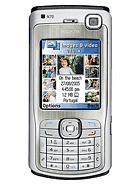
General 2G Network GSM 900 / 1800 / 1900
3G Network UMTS 2100
Announced 2Q, 2005
Status Discontinued
Size Dimensions 108.8 x 53 x 21.8 mm, 95.9 cc
Weight 126 g
Display Type TFT, 256K colors
Size 176 x 208 pixels, 2.1 inches, 35 x 41 mm
- Five-way scroll key
- Downloadable themes
Sound Alert types Vibration; Downloadable polyphonic, monophonic, MP3 ringtones
Speakerphone Yes
Memory Phonebook Practically unlimited entries and fields, Photocall
Call records Detailed, max 30 days
Internal 22 MB
Card slot RS-DV-MMC, 64 MB card included, hotswap, buy memory
Data GPRS Class 10 (4+1/3+2 slots), 32 - 48 kbps
EDGE Class 10, 236.8 kbps
3G Yes, 384 kbps
WLAN No
Bluetooth Yes, v2.0
Infrared port No
USB Yes, Pop-Port
Camera Primary 2 MP, 1600x1200 pixels, LED flash
Video Yes
Secondary VGA videocall camera
Features OS Symbian OS 8.1a , Series 60 UI
CPU TI OMAP 1710 220 MHz processor
Messaging SMS, MMS, EMail, Instant Messaging
Browser WAP 2.0/xHTML, HTML
Radio FM radio; Visual radio
Games Yes + Java downloadable
Colors Silver, Ivory/Pearl, Black (Music Edition)
GPS No
Java Yes, MIDP 2.0
- T9
- SyncML
- Organizer
- Stopwatch
- Image editor
- Xpress-on covers
- Profiles
Battery Standard battery, Li-Ion (BL-5C) 970 mAh
Stand-by Up to 265 h
Talk time Up to 3 h 30 min
Misc SAR US 0.51 W/kg (head) 0.65 W/kg (body)
SAR EU 0.93 W/kg (head)
Price group [About 160 EUR]
Subscribe to:
Posts (Atom)